We only list companies that are trustworthy and appropriately licensed. Our aim is to give you a comprehensive view of the regulated money transfer marketplace.
|Disclosure
MoneyTransfers aims to help users find the best money transfer provider for their needs. To support our free service, we may earn a commission from some of the providers listed in our search results. The commission may also impact the ordering of the providers shown. Our reviews are independent from this and are based on our editorial policy, research and testing of dozens of remittance providers on the market.
Table of Contents
A quoted ringgit deposit lets you compare the money arriving in your Malaysian account before the overseas sender pays.
I'd say start there for local expenses, then compare an international wire if the payer needs to send through their bank.
Cash collection, eligible wallet receipt and foreign-currency accounts provide other ways to receive, depending on where you want to use the balance.
For overseas client payments, choose a service that accepts the commercial purpose and supplies the records needed for that receipt.
Search Now & Save On Your Transfer
Instantly view live exchange rates, fees & features.
At a glance
Ringgit bank deposit: share your matching account name, number and requested bank details.
SWIFT receipt: get incoming instructions from your Malaysian bank for the payment currency.
Cash: collect an eligible Western Union transfer with accepted ID and its reference.
TNG eWallet: use a supported international partner and check your receiving capacity.
Keep currency: use matching receiving details for an eligible bank or Wise currency balance.
Ways to receive money from overseas in Malaysia
Your main decision is whether the money should arrive as spendable ringgit or remain in the original currency for later use.
Option
Best fit
What you share
Limitation to check
Transfer company paying your bank
Personal support in MYR
Matching name, bank and account number
Sender residence and chosen payout method
International bank wire
Payment sent directly by an overseas bank
Beneficiary and SWIFT instructions
Conversion, correspondent fees and bank checks
Foreign-currency account
Holding supported currencies
Currency-specific account details
Eligibility and incoming payment charges
TNG eWallet
Money you will use through the wallet
Details requested by an international partner
Wallet and sending-service limits
Cash collection
Receiving without a bank deposit
Accepted photo ID and transfer reference
Agent hours and payout availability
Receive ringgit into your existing bank account
Your sender can use a service such as Wise, Remitly or Western Union to deliver MYR into a Malaysian account.
The sender opens the transfer account and pays abroad, while you receive the money through the beneficiary bank details you supply.
For example, receiving money from Singapore in Malaysia can mean the sender pays SGD and you receive a quoted amount in ringgit.
You generally do not need an account with the same transfer company when the selected method is an ordinary bank deposit.
If you also need to send money overseas, compare money transfer apps in Malaysia on their funding methods and delivery options.
Prepare the following information requested by the company handling the payment:
Your full name as recorded by the bank.
Bank name and account number.
Bank code, branch or SWIFT/BIC when requested.
Your address, contact number and the payment purpose.
A transfer company can use local payout arrangements, so its bank-deposit instructions may differ from the instructions for a foreign bank wire.
I suggest considering a quoted MYR deposit for family support when seeing the final ringgit amount is more helpful than holding foreign currency.
For a supported payment from Singapore, register your mobile number as a DuitNow ID linked to your participating Malaysian bank account or eWallet.
The sender then uses the PayNow overseas option offered by their participating Singapore institution, entering your registered mobile number and confirming the recipient details.
You receive ringgit, with the sender able to review the exchange rate and receiving amount before confirming the cross-border payment.
Check that both institutions support this link and the amount requested, since domestic DuitNow availability alone does not establish overseas receiving access.
Receive a SWIFT transfer through your bank
If a foreign bank sends the payment directly, ask your Malaysian bank for its incoming telegraphic-transfer instructions in the chosen currency.
Give the sender your beneficiary name and account number, the bank’s SWIFT/BIC and any branch, address or correspondent details required.
Maybank uses MBBEMYKL as its SWIFT code, but your account details and the payment currency still need to match its receiving instructions.
Ask whether the account accepts the original currency or converts it to MYR before crediting, particularly when the sender wants to send USD.
Your bank can ask about the transfer’s source and purpose, so keep the receipt and documents showing why the money belongs to you.
For an invoice payment, that can include a contract and invoice, while family support may need records explaining the relationship and source.
I'd say choose the wire route when the payer needs to use its own bank or when the payment must reach an eligible currency account.
Check incoming and intermediary charges before agreeing an exact amount, because the sender’s debit and your final bank credit can differ.
Receive and hold foreign currency
A foreign-currency account lets you retain supported incoming currency rather than converting every payment into ringgit on arrival.
Maybank’s Master Foreign Currency Account offers a bank option, while eligible inward telegraphic transfers can also fund supported currencies in its Global Access Account-i.
Check which account fits your residency and payment source, then obtain its currency-specific incoming instructions before the sender pays.
I like keeping currency when you expect expenses in that same currency, because converting into MYR and back again adds another exchange.
You still face exchange-rate movements, account requirements and any withdrawal or onward-payment charges, so retention is a choice rather than a guaranteed saving.
Wise is another personal option for receiving supported currencies through the account details available in your Malaysian account.
For example, a supported local GBP payment can reach your GBP details without being converted immediately into ringgit.
Malaysian personal Wise accounts have a combined holding limit of RM20,000 equivalent across currencies, so check capacity and its handling of excess receipts.
Share the details for the actual payment method, because local receiving instructions and SWIFT instructions can be different even for the same currency.
Our multi-currency accounts in Malaysia guide covers account selection, while this page focuses on getting the incoming payment to the right destination.
Receive into TNG eWallet
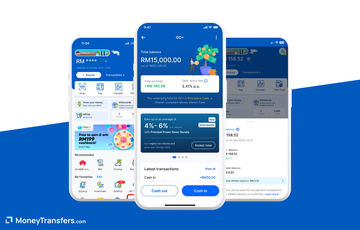
TNG eWallet supports receiving money from overseas through its international partners, giving you an alternative when you intend to use the wallet balance.
In the app, open Add Money, choose International Options and select a supported partner to see the receiving instructions.
The overseas sender must use a partner and route that can pay your wallet, rather than sending to an arbitrary Malaysian phone number.
Check your registered details and the amount your wallet can receive before providing the sender with the instructions shown.
The inbound service is capped by the sending bank or wallet and the receiving account’s limits, including TNG eWallet’s RM20,000 ceiling.
I suggest comparing this with bank receipt if you will later move the money elsewhere, since an extra withdrawal or transfer can change the total cost.
Our mobile money transfers in Malaysia guide covers wallet features and receiving options beyond the immediate overseas payment.
Collect money in cash
Western Union supports cash pickup in Malaysia, so you can receive an eligible transfer at a participating agent without bank deposit.
Ask the sender to choose cash pickup and use the name shown on your identification, then obtain the Money Transfer Control Number.
Take accepted government-issued photo ID and the reference, with the sender’s name, sending country and expected amount available if requested.
Confirm that the transfer is ready and check the agent’s hours and identification requirements before you travel.
Cash suits you when bank access is unavailable, although I'd say check the collection amount against bank delivery before choosing it for regular support.
What does receiving money from overseas cost?
The final ringgit amount depends on who converts the money, the sender’s fee and any charges deducted by banks along the route.
Cost
Where it applies
What to compare
Sending fee
Transfer company or foreign bank
Total amount paid by the sender
Exchange rate
Company or bank converting the payment
MYR credited for the same sending amount
Intermediary charges
SWIFT payment chain
Fee-sharing instruction and possible deductions
Receiving charge
Your bank or account
Account tariff for that incoming method
Withdrawal or onward transfer
Accessing a wallet or foreign-currency balance
Cost after the initial credit
Maybank’s remittance tariff includes an RM5 service charge for inward remittances received from other banks, while other incoming categories have different treatment.
That small receiving charge does not describe the complete wire cost, because conversion and correspondent deductions can have a larger effect.
These rounded sending amounts illustrate personal payments worth roughly RM3,000 before fees, including an existing SGD1,000 comparison from Singapore.
Last updated at 16/10/2026
SGD MYR
Mid Market Rate$1 = RM 3.1875
Transfer Amount$1,000
1
Instarem
2
Wise
3
Revolut
Transfer amount
They get (after fees)
Transfer fees
FX Rate
Markup
Delivery time
$1,000.00
RM 3,184.80
$0.00
3.1848
0.08%
Minutes - 24 hours
$1,000.00
RM 3,178.49
$3.08
3.1883
-0.02%
Within minutes
$1,000.00
RM 3,177.46
$1.50
3.1822
0.17%
Within minutes
GBP MYR
Mid Market Rate£1 = RM 5.4313
Transfer Amount£600
1
TapTap Send
2
Revolut
3
Wise
Transfer amount
They get (after fees)
Transfer fees
FX Rate
Markup
Delivery time
£600.00
RM 3,246.00
£0.00
5.4100
0.39%
Minutes
£600.00
RM 3,245.27
£0.30
5.4115
0.37%
Within minutes
£600.00
RM 3,243.13
£2.77
5.4303
0.02%
Within minutes
USD MYR
Mid Market Rate$1 = RM 4.084
Transfer Amount$800
1
Remitly
2
TapTap Send
3
Revolut
Transfer amount
They get (after fees)
Transfer fees
FX Rate
Markup
Delivery time
$800.00
RM 3,273.68
$0.00
4.0921
-0.20%
Within minutes
$800.00
RM 3,256.00
$0.00
4.0700
0.34%
Minutes
$800.00
RM 3,251.21
$1.20
4.0701
0.34%
Within minutes
AUD MYR
Mid Market Rate$1 = RM 2.8351
Transfer Amount$1,200
1
Remitly
2
TapTap Send
3
Western Union
Transfer amount
They get (after fees)
Transfer fees
FX Rate
Markup
Delivery time
$1,200.00
RM 3,434.28
$0.00
2.8619
-0.94%
Within a week
$1,200.00
RM 3,396.00
$0.00
2.8300
0.18%
Minutes
$1,200.00
RM 3,390.11
$0.00
2.8251
0.35%
Minutes - 2 days
EUR MYR
Mid Market Rate€1 = RM 4.5851
Transfer Amount€700
1
TapTap Send
2
Revolut
3
Wise
Transfer amount
They get (after fees)
Transfer fees
FX Rate
Markup
Delivery time
€700.00
RM 3,199.00
€0.00
4.5700
0.33%
Minutes
€700.00
RM 3,197.07
€0.40
4.5699
0.33%
Within minutes
€700.00
RM 3,189.39
€4.34
4.5847
0.01%
Within minutes
Use the quote for your sender’s country and match its payout method to the account or wallet you have chosen.
How long does it take?
A funded transfer company payment can reach you quickly, while a SWIFT transfer commonly needs several working days across the banks involved.
Identity checks, public holidays and missing payment information can extend the time before you can use the credited funds.
A tracking message saying the beneficiary bank received the payment can still precede the bank releasing it into your available balance.
For cash collection, check that the money is ready and the agent is open rather than relying only on the sender’s payment receipt.
Limits and checks for incoming money
Malaysia’s foreign-exchange rules distinguish payment and receipt from foreign-currency investment, so an investment allowance should not be copied as a universal inward-transfer cap.
Your bank or wallet and the sending company can still set transaction limits or ask for documents about your source and purpose.
Use BNM’s Payment and Receipt rules for the relevant residency and transaction, especially if the payment relates to work or an investment.
For large receipts, keep statements, sale agreements, inheritance documents or gift records that explain the source before the bank requests them.
Do you pay tax on overseas money received in Malaysia?
A foreign sender or overseas bank account does not by itself make the money foreign-sourced income under Malaysian tax rules.
Work carried out in Malaysia can produce Malaysian-sourced income even when the client pays you from another country.
Resident individuals can qualify for exemption on eligible foreign-sourced income received in Malaysia, subject to the applicable category and conditions.
Partnership business income follows different treatment, so avoid applying an individual exemption to every overseas business payment.
Moving existing savings and receiving a gift also need to be distinguished from earning salary, fees or investment income.
Keep evidence of the income source and overseas tax treatment, and check LHDN’s current return guidance for any required exempt-income disclosure.
Receiving payment for your work
A personal remittance quote does not establish that the service accepts your client payment or supports your business account.
Confirm the commercial purpose, account eligibility and invoice records first, then compare business multi-currency accounts for collecting and retaining foreign client payments.
How to receive money from overseas in Malaysia
Choose the destination and currency
Decide whether you need ringgit now, cash collection or supported foreign currency, then select an account or wallet that fits.
Get the receiving instructions
Copy the details for bank deposit, SWIFT or the wallet partner, and check that the beneficiary name matches your account.
Agree the quote and purpose
Ask the sender to check the final recipient amount and correct payment purpose before funding the transfer.
Answer any bank request
Provide source or purpose documents through the bank’s own channel, then retain the receipt and evidence supporting your payment.
What if the money has not arrived?
Check the sender’s transfer status and receipt first, including the beneficiary account, currency and expected delivery date.
If the payment has reached your bank but remains uncredited, contact its remittance team and ask whether documents or payment instructions are missing.
For a SWIFT transfer, ask the sender to obtain payment confirmation or an MT103 where available and request a trace through the sending bank.
For TNG eWallet, check the chosen international partner, registered recipient details and wallet capacity before raising the missing credit with support.
The sender should request any correction through the sending service, while you handle requests from your Malaysian receiving institution.
If less money arrives
Compare the original quote and payment currency with your credit, then ask whether your bank converted the money or deducted an incoming charge.
Intermediary fees can also reduce SWIFT receipts, so request the payment’s charge breakdown before arranging another transfer.
Check the next personal transfer with your sender using the form below, including the receiving method you intend to use.
Compare transfers to Malaysia
Enter the sender’s country and amount, then choose Malaysia as the destination to compare available transfer rates and fees.
Our methodology & why trust us
We reviewed Malaysian bank instructions and tariffs, wallet receiving guidance, BNM payment rules and LHDN material relevant to overseas receipts.
Our comparison uses fixed inward examples roughly worth RM3,000 before fees, with the original sending amount visible for each origin.
I prioritised clear receiving instructions and access to the credited money, including held-bank-payment tracing and options for retaining currency.













Please share your experience with …